Project ECHO
About the Educational Model
The ECHO Model
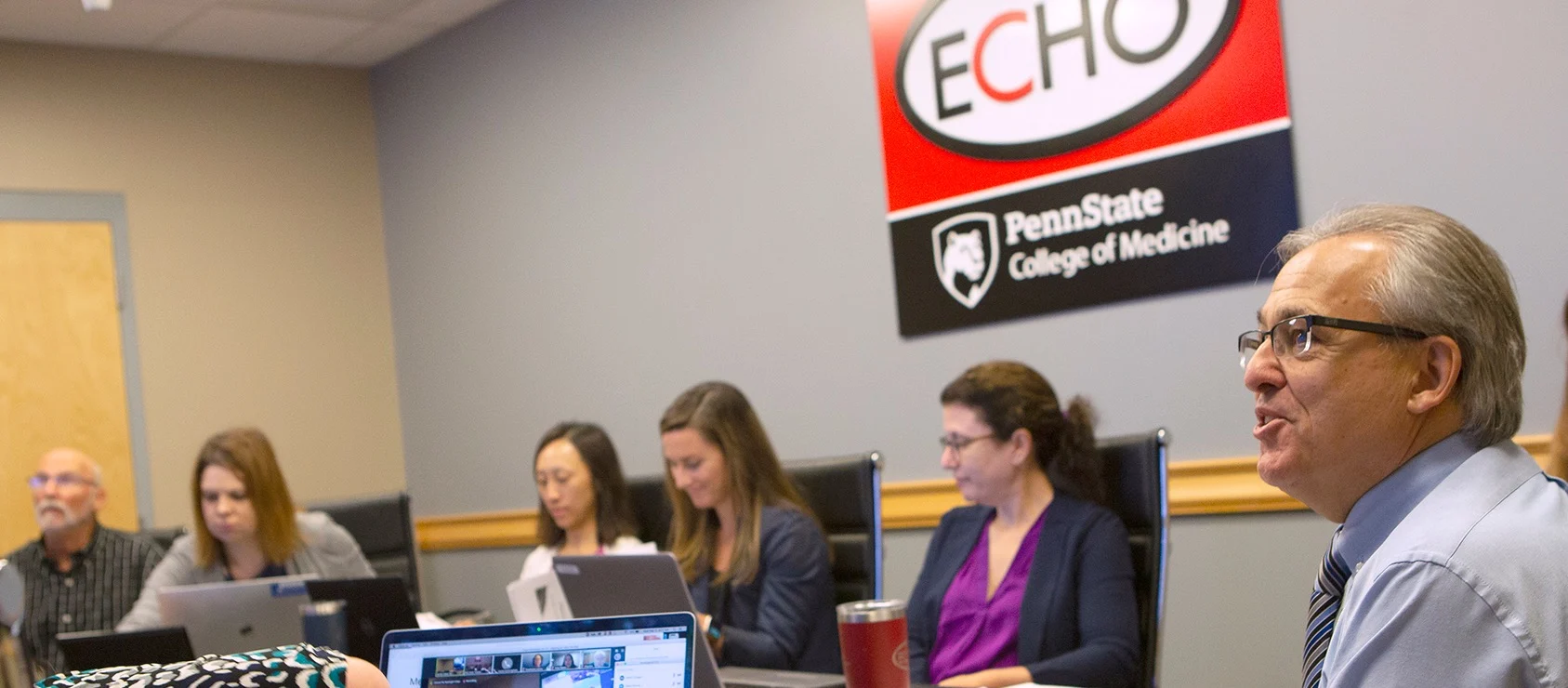
The ECHO Model is not traditional telemedicine, where specialists take over patient care. Instead, it’s a collaborative approach that helps professionals and community members exchange expertise, gain confidence, and solve real-world challenges together. In ECHO sessions, participants and experts learn from one another in an “all teach, all learn” environment that spreads knowledge and strengthens skills across communities.
Our Approach
We’ve expanded this model beyond healthcare to support community health workers, social workers, educators, community leaders, workforce development professionals, and families. By adapting ECHO to a wide range of topics, we create opportunities for connection and shared learning that build local networks and turn knowledge into action for healthier, more resilient communities.
Our Impact
Over time, Project ECHO at Penn State has expanded its reach, demonstrating how collaborative, case‑based learning can support professionals and communities across a wide range of settings. This ongoing work is documented through reporting that highlights program growth, outcomes, and how the ECHO model continues to evolve across Pennsylvania and beyond.
Is Penn State Project ECHO Right for You?
Watch the short video below to see how Penn State Project ECHO works in action and discover if it’s the right fit for you, your team, or your community. Learn how you can participate, collaborate, and make a real impact in the areas you care about most.
Project ECHO Details
An ECHO session is virtual telementoring.
Primary care providers from multiple locations connect with a team of specialists through video conferencing.
Providers have the opportunity to present complex patient cases and receive guidance from experts.
Case-based discussions are supplemented with brief presentations to improve content knowledge and share evidence-based best practices.
Providers also receive no-cost CME credits for each ECHO session attended.
Physician/physician assistant/nurse practitioner Development and retention
Acquire new skills and competencies, expanding access to care.
Become part of a community of learners.
Increase professional satisfaction and decrease feelings of professional isolation.
Continued Learning
Enjoy no-cost access to continued learning
Specialist consultations during sessions.
Increased Efficiency
Health centers are part of a professional network and referral network, making it easier to get patients in to be seen, a process that previously could take weeks.
The ECHO model dramatically improves health outcomes for patients while bolstering patient retention and satisfaction. When a local health center adopts ECHO:
Many patients no longer have to travel long distances to see a specialist
Patients with a wide range of chronic, complex conditions can be treated close to home, without waiting months for an appointment.
Patients are more likely to adhere to treatment and follow-up care when treated by local providers they know and trust.
Patients benefit from expert consultations between providers and academic specialists.
Time constraints have been identified as one of the most significant challenges for health centers.
Most ECHO sessions occur before office hours or during lunch and do not to take away from provider-patient time.
Project ECHO is a powerful tool in recruiting and retaining providers.
In rural and urban areas, health center providers often feel professionally isolated.
ECHO allows for professional development, CME credits and access to a knowledge network of peers and experts.
Increased provider satisfaction often results in greater provider retention.
All levels of providers are welcome and highly encouraged to participate in ECHO sessions. This includes:
Physicians
Physician assistants
Nurse practitioners
Registered nurses
Psychiatrists
Social workers
Community health workers
Pharmacists
Participation in ECHO sessions is free. The only associated costs are those for IT equipment (if needed) and time away from clinic.
Most sessions occur early in the morning or during lunch hours to minimize the time away from direct patient care.
Most clinics possess the required IT equipment to connect via video.
The technology can be as simple as using a laptop, tablet or phone.
ECHO sessions utilize the Zoom platform.
Zoom works well on mobile devices such as iPhones, iPads and Androids, and has web-conferencing features like chat and sharing.
Participants who join ECHO sessions receive CMEs for the total time spent participating.
CME credit is offered by the University of New Mexico School of Medicine, Office of Continuing Medical Education.
To claim CME credit, a short evaluation must be completed within 48 hours after each ECHO session.
All CMEs from participation in ECHO sessions are given at no charge.